Rody Bolands
ESTD 1847
OUR HISTORY
Rody Boland’s Heritage Pub
What stands today at 12–14 Upper Rathmines Road is the extraordinary fusion of two public houses: one urban, one rural; one rooted in the expanding suburbs of Victorian Dublin, the other in the agricultural and commercial life of Nenagh, County Tipperary. Their stories developed independently for generations, yet their paths repeatedly crossed through people, families, tradeand circumstance before finally becoming one. The two locations were 12–14 Upper Rathmines Road, Dublin, and 27–28 Queen’s Street, later Mitchell Street, Nenagh, Co. Tipperary. Their histories now reside beneath the same roof. Rody Boland’s is therefore not simply a historic Dublin pub. It is the physical meeting place of two Irish pub traditions.
(Rathmines) From Farmland to Township
The story begins in Rathmines, an area whose transformation mirrors the development of Dublin itself. Taking its name from the Norman De Meones family, Rathmines was once fertile countryside beyond the walls of the city. By the 1830s, however, development was accelerating and a population of approximately 1,600 people was concentrated around the small triangle formed by the modern Upper and Lower Rathmines Roads. The passing of the Municipal Reform Act in 1840 and the establishment of Rathmines as a township in 1847 helped accelerate the area's development. Rathmines was becoming an increasingly prosperous suburban centre, connected increasingly closely to Dublin by improved roads and, later, by tramways.
(Rathmines) Community Morgue Licences
During the height of the Irish Famine in "Black '47", Dublin experienced a massive influx of starving, and emaciated people fleeing the rural countryside. The resulting overcrowding led to devastating outbreaks of diseases like typhus, cholera, and dysentery. Because the death toll in the city increased both so rapidly and so unexpectedly, traditional hospitals and mortuaries completely collapsed under the pressure. To manage the crisis, the authorities issued unique emergency permissions—frequently referred to in local history as morgue licences. At that time dead bodies were regularly being discovered on the streets and banks of the city's rivers and canals. To alleviate this situation in Dublin’s worst affected areas businesses were asked to provide a room where bodies could be stored prior to identification and burial. The upside of this was that such premises were granted a full 7-day drinks licence. In this manner the grocery store of James Coffey, established in May 1846, became a licensed premises one year later in 1847 fulfilling the obligations contained in the community morgue licensing. In the same year Rathmines was established as a Township, which heralded a period of great economic expansion within the area. It seems like James Coffey had shrewdly anticipated all of this in advance.
(Rathmines) The Famine Licence
Conscious of the expanding profile of Rathmines and the developing opportunities ensuing, a wily, confident and ambitious young man named James Coffey approached Maria Baxter, who held the freehold interest of what was then numbered no. 22 Rathmines, requesting a lease on the premises to run a grocery business. Miss Baxter consented and on May 29th 1846, shegranted James Coffey a lease for the annual rent of £19-19-0, which was quite expensive at that time. But the wily James Coffey knew that to make ends meet, pay the annual rent and show a profit he needed something greater than his grocery income alone, which in that era was dominated by the ‘slate,’i.e. credit facilities that in many cases remained outstanding for months. The circumstances surrounding that licence belong to one of the darker episodes in Irish history.

(Rathmines) The Coffey Dynasty Years
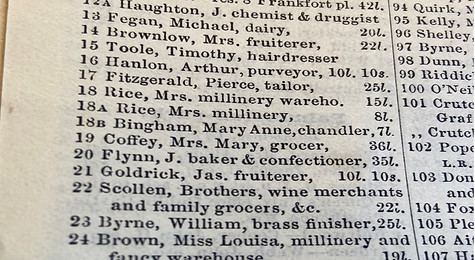
Though the worst affects of Ireland’s famine had reduced by 1849, the premises designated as community morgues had, under the provisions of law, to continue providing the morgue facility (in most cases, a single room). This however did deter James Coffey from expanding his business, and in many respects it helped considerably. Coffey remained in situ here at no. 22 Rathmines for exactly 25 years until he passed away in 1872. But during those years the Coffey empire had grown and grown. His wife Mary had run a grocery at no. 17, which their son Pat expanded into a major provisions store. John Coffey, another son of James and Mary, established a pub and grocery at no. 18 Rathmines.
(Rathmines) Arrival of the Scollen Brothers 1872
The expanding township of Rathmines, which had grown to a population of 20,562 persons by 1871, was now a magnet for enterprising publicans who wanted to explore new opportunities. The Dublin Tramway provided an excellent transport system with trams to Dartry, Rathgar and Milltown passing the door of no. 22 Rathmines, which in 1872 boasted new signage: Scollen Bros, Wine Merchants & Family Grocers. The Scollen brothers, James and Michael, were hard working, diligent publicans, who were prepared to put in the hard hours and build a steady business from the ever increasing footfall around Rathmines. For the next thirteen years, the brothers grew their business combining both grocery and the drinks trade.

Meanwhile in (Nenagh) 1873
While the public house in Rathmines was passing from Coffey to Scollen, the market town of Nenagh was developing its own licensed and commercial culture. Nenagh, which was a pivotal stop over on the Dublin – Limerick route was in the 1870s thriving due to the presence of flour and corn mills, brewing and iron works. It’s population, which had fallen dramatically post famine, was now increasing year on year. These were the background conditions that led to Clareman Michael McMahon setting up a Pub, Grocery and Merchants Store at 27-28 Queen’s Street in 1873.
(Nenagh) The Business Expands
Nenagh’s thriving location was boosted considerably by its local markets and the growing importance of agriculture in the greater Nenagh area. The influx of people into town on market days boosted local pub, grocery and merchant stores like McMahon’s of Queen’s Street. Here again was a business in which the public house, grocery and merchants store existed side by side. But the downside was that cashflow was scarce and most consumers bought on credit which meant that all merchant stores were carrying lots of debt.Scollen Brothers to the Masterson Family Rathmines- 1885 Back in Rathmines James and Michael Scollen continued to run a tight ship on this old hostelry of liquid culture combining the less profitable grocery trade with the more lucrative drinks trade. The Scollens were ambitious publicans who wanted to move closer to the city with higher footfall and a larger premises. This was music to the ears of a local Rathmines merchant family named Masterson, who envisaged great future potential for no. 22. For some weeks the Mastersons haggled with the Scollen Brothers over price and a deal was finally struck which enabled Philip Masterson to take possession of this house on Christmas Eve 1885, just in time to catch to the pre-Christmas trade. The first actions of Philip Masterson was to install his brother Michael here as licensee while he himself continued to run a very large grocery and provisions store at no. 19 Rathmines. The building itself was immediately swept up in the great Victorian reconstruction of Rathmines. The old premises was demolished and replaced by a more imposing structure in keeping with the red-brick architecture transforming the township. Inside, the Mastersons created the familiar Victorian combination of pub and grocery. Mahogany counters, a backbar, snug and an array of drawers, shelves and bins allowed the premises to function as both public house and provisions store. Tea was the most popular item availed of as the Victorian pubs stored their teas in lead lined bins which they made from the off cuts of mahogany used on their counters and backbars. In stark contrast, the tea in provisions stores was held in thin plywood tea chests, which deteriorated in quality in cold and damp climatic conditions. This had the immediate effect of bringing the previously reluctant Victorian ladies into the public house.


(Rathmines) Public Auction
The Arrival of John Butler
The family partriarch Philip Masterson passed away in 1898 and his brother Michael decided to put this premises up for sale. Publican John Butler paid £3,150 for this premises at public auction on February 2nd 1899 – an enormous sum in those days. But this was a period of affluence for Dublin’s licensed trade as low inflation, price control, wage control and plentiful employment brought about an economic boom. The social conservative ways of caution and fear gave way to a new spirit of vitality and opportunity abroad,which translated into regular social expression in public houses. These were good years for John Butler, Wine Merchant & Family Grocer.
(Nenagh) Edward Boland enters the Nenagh Story
Meanwhile, the business of Michael McMahon at 27-28 Queen’s Street, Nenagh expanded over the years as demand grew in the Merchants department for solid fuels, hardware and agricultural items. Side by side with this was his grocery and drinks trade. Along the way Michael had married Julianna and before the turn of the 20th century they had a baby daughter named Evelyn. At this time also McMahon employed a young shop assistant named Edward Boland, who would play a very important role in the future of this store and the traditional Rathmines pub grocery that would one day bear his son’s name.


(Rathmines) James & Edward Kennedy
Nenagh Comes to Rathmines
By 1910 the name J & E Kennedy, Wine Merchants and Family Grocers, hungproudly above the door at no. 22 Rathmines. It is one of the extraordinary coincidences which gives the story of Rody Boland's its particular fascination. The Rathmines premises and the Nenagh premises were still separate businesses, yet people from the same North Tipperary town were becoming associated with the Dublin pub. The J above the door stood for eldest brother James who was joined in this venture by his two younger brothers Edward and Philip. But the E above the door stood for Edward Kennedy Senior, a farmer from Nenagh, who had bankrolled this venture for his three sons. But tragedy struck this family in May 1912 when 37-year-old eldest brother James died. The customary step for a publican would have been to bequeath the pub to one of his children, but as James Kennedy wasn’t married this pub was willed to his elderly father in Nenagh, Edward Kennedy, who in turn bequeathed the pub to his second eldest son, also named Edward, who along with his brother Philip worked as a shop assistant in the family business. For the next 35 years this pub was run by brothers Edward and Philip Kennedyalthough the name above the door remained unchanged.
(Nenagh) Death of Michael McMahon in Nenagh
In the same year of 1912 that James Kennedy died, a remarkable coincidence of fate occured between these two premises, though still phycsically separate. Michael McMahon, proprietor of Michael McMahon’s, Pub, Grocery and Merchants, 27-28 Queens Street, Nenagh died after a long illness in June of that year. Michael had been in poor health for sometime having been hospitalised for over a year. The 1911 Census records his absence from the house as his wife Julianna is listed as publican, and the head of the household. Also on that census form can be found the name of Edward Boland, Shop Assistant and Bachelor, then aged 28 years, who was living on the premises. Julianna McMahon, who was not a natural business woman and publican, found it difficult to manage the affairs of this large business after her husband’s death and in the following years the responsibilty for running this premises fell on the shoulders of Edward Boland, who eventually bought the premises from Julianna McMahon. Boland was married in in 1917, and a daughter Mary was born to them in 1918, followed by a son Rody a year later in 1919.


(Nenagh) The Bolands of Nenagh
Edward Boland was no stranger to the business he had purchased from the McMahon family as he had been the de facto operator of the business for many years. He was well respected within Nenagh family and commercial circles and his store became a one-stop-shop for all community needs. But the stormclouds of change were blowing fiercely in Irish social, economic and political life in those years. The Irish War of Independence was in full flow at this time within which Tipperary men played a major part. This was followed by the Treaty and the Irish Civil War which forced families to take sides. The Boland family were strongly republican in outlook, a conviction that would influence young Rody throughout his life. The infant years of the new Irish Free State were economically difficult. This did not mean, however, that businness was slow. On the contrary, business was brisk, but cash was almost non-existant. This increased the demand for credit exponentially, which forced businesses to massively increase their bank debts in order to facilitate customers. The Economic War between Britain and Ireland in the 1930s hit Irish farmers very hard, who in turn incurred big debts in merchants stores, such as Edward Boland’s. Something had to give andeventually the strain became too much – Edward Boland’s businness closed its doors for the last time in 1935. The building fell silent. But its contents did not disappear. The mahogany fittings, counters, shelves, presses, signage, documents, photographs, letters and—most revealingly—the customer ledgers survived. They would remain hidden away for almost sixty years. 71-year-old Edward Boland passed away in 1954 leaving his son Rody as custodian and curator of the family heritage.
(Rathmines) After the Kennedy’s
The Kennedy brothers finally departed in 1947 after 37 years at the premises. The new name above the door became George O'Connor, Wine & Spirit Merchant, of what was now no. 14 Upper Rathmines. The old grocery function of the Dublin pub was by now disappearing. The growth of specialist shops, street traders and larger provisions stores made it increasingly difficult for publicans to compete in the grocery business. Over the next 45 years this house changed hands on a number of occasions under the various titles of Slattery’s, the Hideaway, the Concorde and latterly Streets. When the premises came on the market once more in 1993 it was acquired by Nenagh-born publican Kieran O’ Meara, who envisaged bringing the heritage and culture of his hometown lock, stock and barrel to Dublin.

Rody Bolands Comes to Rathmines –
Two Histories are One
In an ingenious and audacious move Kieran O’ Meara, himself a native of Nenagh, and another coincidential connection between these two premises, approached Rody Boland about buying the entire contents of his family business, which had remained mostly intact since the business closed in 1935. Rody consulted with his brother and then consented to sell the entire interior of his family business to Kieran. A major reconstruction was already taking place in what was now nos. 12-14 Upper Rathmines, and when completed, the interior of Edward Boland’s Pub, Grocery and Merchants Store became the vibrant living soul of what is now Rody Boland’s. The completed premises was akin to a journey back in time to the Nenagh of the 1930s, and to Irish pubs exuding the authentic character of yesteryear. Suddenly, something remarkable had happened. The pub in Nenagh that had closed in 1935 had, in effect, reopened in Dublin in the 1990s. But it had not simply been copied. It had been transplanted.
But Rody Boland’s is much more than a pub and a venue of social entertainment; in reality it is a veritable museum experience showcasing the original Boland’s exterior sign, all the backbar, counters, mahogany drawers, shelves and presses. Within those presses are contained the original shop credit ledgers from Nenagh illuminating the social and economic life of the people, how they lived, what they bought and what they owed to the Boland family business. The contents of these ledgers, artefacts, letters and images are much more than pub memorabilia. They are primary agents of culture, fragments of social history, providing a rare glimpse into the social and economic life of provincial Ireland.
Rody Boland’s Today
Rody Boland’s, which today lies the safe hands of Brian O’ Meara, is muchmore than a public house. It is a microcosm of Irish life itself, a living narrative that goes on and on but is constantly reflective of the past, and of the great cultural heritage that constitutes the Dublin pub. And this is a narrative that essentially defines the great intermingling of two premises whose histories are now one, but who have been connected through the decades by many remarkable coincidences of fate, fortune and personality – none moreso than Rody Boland.
Rody Boland’s is not simply the history of a pub. It is the story of two pubs whose separate journeys eventually converged, allowing the past of Nenagh and the heritage of Rathmines to become one living institution.